








Four trays hit the bin at closing. Same weight, four different failures: one batch was over-prepped after a promotion ended, one exceeded its approved hold window, one was rejected after an equipment problem, and customers returned the fourth. A waste dashboard sees four trays. The kitchen needs four causes.
AI for restaurant food waste management is useful only if it traces each loss to the decision that caused it, then corrects that decision without creating a stockout. Demand forecasts guide purchasing, thawing, prep, batch size, and timing. Waste and stockout signals return to planning with enough context to change the next recommendation.
The work begins upstream of the bin: prevent the discard, record the outcome, and use the cause data to adjust the next plan at store, item, and daypart level.
Predictive waste management starts before the bin
The US Environmental Protection Agency ranks preventing wasted food above downstream management options such as composting or landfill. Its guidance for businesses starts with a waste audit, then compares purchasing and inventory with customer ordering and examines production, handling, and storage practices.[1]
That distinction matters. A smart bin can measure a discard, but it cannot prevent the next one unless the data reaches the decisions upstream. A forecast can predict lunch demand, but it cannot explain why twelve portions were discarded unless the system also knows what was prepared, how long it was held, what was sold, and what the crew recorded at disposal.
The same problem appears in market data. ReFED estimates that US restaurants and foodservice businesses generated 12.5 million tons of surplus food in 2024. It attributes almost 70 percent to plate waste and 11.9 percent to overproduction.[2] Those figures cover the broader foodservice sector, not QSRs alone, but they expose the flaw in treating every discard as forecast error. Smaller batches may address overproduction. They will not fix oversized portions, quality rejects, or an unpopular side. AI for restaurant food waste management therefore has to separate demand-planning errors from causes that forecasting cannot fix.
Closing the loop: from forecast to bin and back
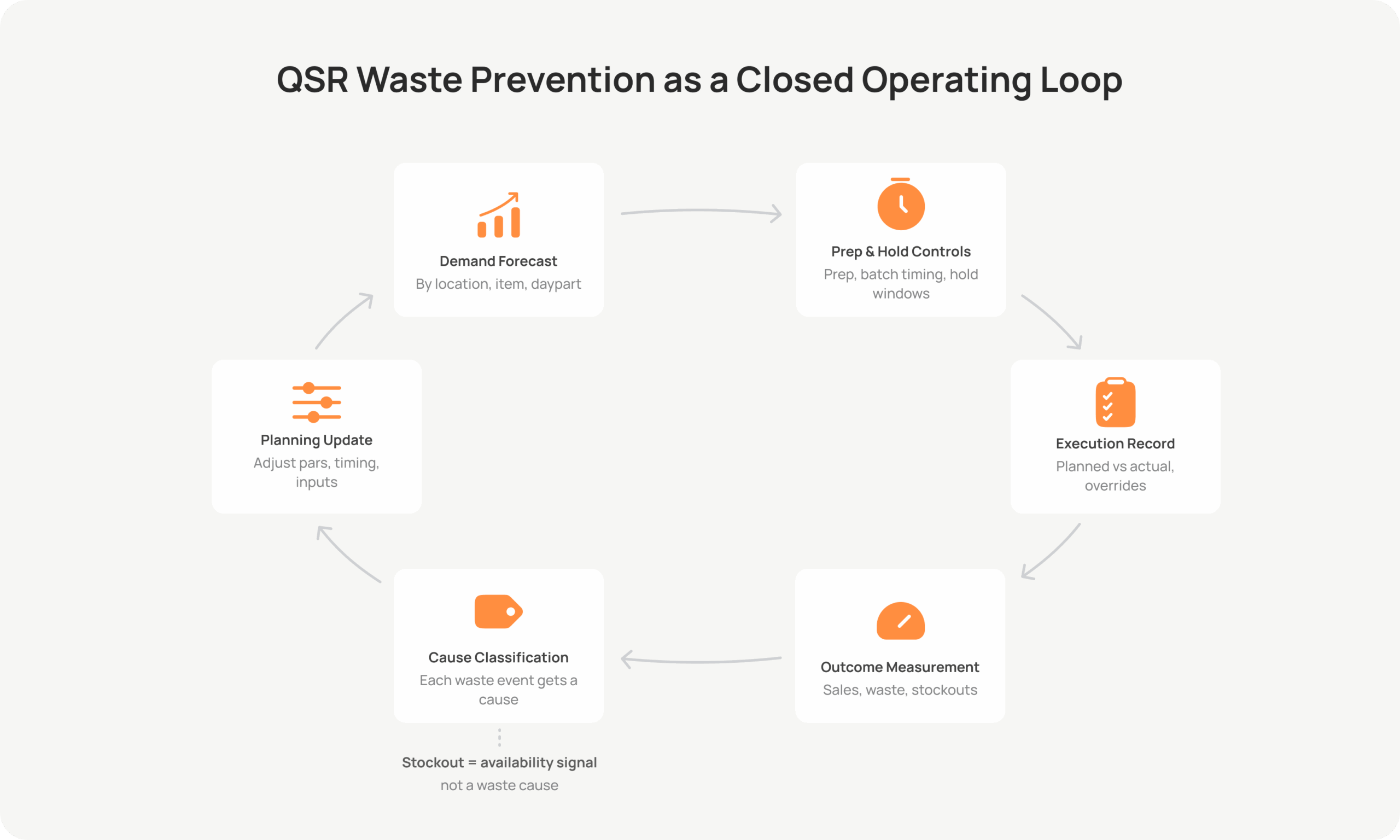
A useful system connects six stages.
- Predict demand at the decision level. Build forecasts by location, item, and daypart rather than chain-level sales alone. POS history is the base signal. Promotions, catering orders, local events, weather, closures, and channel mix can be added when they improve a decision at the required horizon. AWS describes a similar end-to-end pattern for restaurant demand forecasting, with ingestion, scheduled prediction, and business-facing output.[3]
- Translate demand into kitchen controls. A forecast for 140 sandwiches is not yet an instruction. Recipe and yield data, current stock, thaw time, batch limits, station capacity, and approved hold windows must turn it into tasks such as “thaw 80 portions by 9:30” or “start the next batch at 11:45.”
- Capture execution. Record planned and actual batch quantities, prep times, hold start and end times, substitutions, manager overrides, and equipment outages. Without this layer, the system cannot tell whether the forecast was wrong or the plan was not followed.
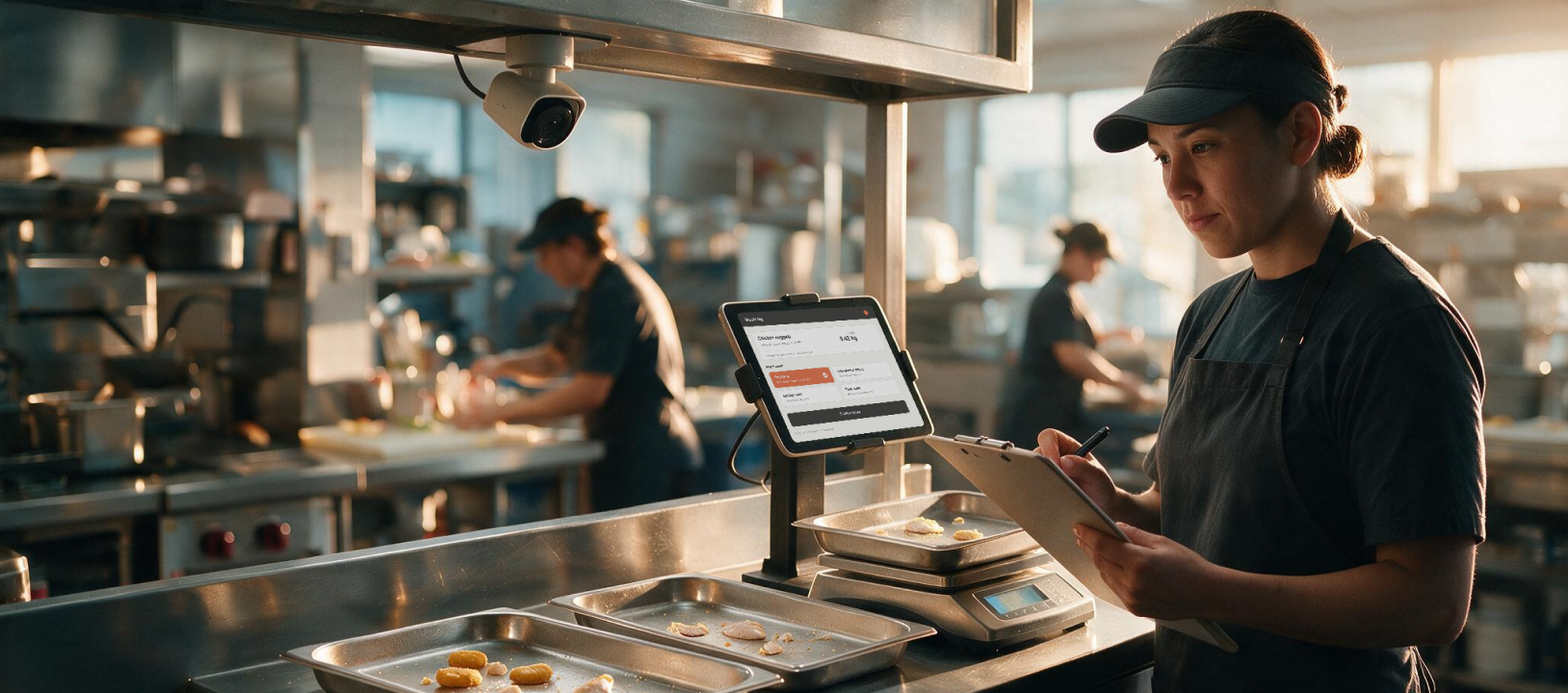
- Measure outcomes. Combine POS sales, inventory movement, waste logs, holding data, and stockout periods. Cameras and weight sensors can reduce manual logging at high-value waste points, but they are optional instruments, not the architecture itself.
- Assign a cause tied to a decision. Tag the event as over-prep, hold-window expiry, spoilage, trim or yield loss, quality reject, remake, or plate waste. Keep stockout as a separate availability signal. It is not a waste cause, but it can suppress observed sales and corrupt the next forecast.
- Feed the result back. Update pars, batch timing, purchasing, yield assumptions, and model features only when the evidence supports the change. A repeated lunch over-prep pattern should affect lunch prep. It should not automatically reduce the all-day target for every store.
Each handoff needs a defined data contract. At minimum, store the location, item or ingredient, daypart, planned quantity, actual quantity, event time, measured amount, cause, capture method, confidence, and any manager correction. If the system cannot trace a recommendation back to those records, operators cannot audit it.
Cause data is more useful than a single waste number
Cause labels matter only when they map to different actions. Over-prep calls for a forecast or batch-size change. Hold-window expiry points to batch timing. An equipment-related reject requires maintenance. Plate waste points to the product, portion, or customer behavior. A chain-wide waste total erases those distinctions and gives a shift lead almost nothing to act on.
This is where restaurant waste tracking often fails. Manual reason codes are skipped during a rush. Computer vision can misclassify mixed items or struggle with steam, occlusion, changing light, and dirty containers. Scales measure weight but not cause. POS data shows sales but not what customers wanted after an item sold out.
Use several signals and preserve uncertainty. A camera may suggest an item, a scale may provide quantity, a holding system may identify the batch, and a crew member may confirm the reason only when confidence is low. Do not let an uncertain event silently retrain the model. Route it for review, exclude it from automated learning, or retain it as unclassified.
Build failure controls before automation
The dangerous version of predictive waste management is a bad recommendation that reaches every store without resistance. Production controls should be boring and explicit.
- Food-safety and approved quality windows remain hard policy limits. AI may change batch quantity and timing within those limits, not rewrite them.
- Large changes for expensive or slow-to-thaw items need caps or manager approval.
- Manager overrides need reason codes and outcome capture. A local school event, late delivery, broken fryer, or unusual queue may not exist in the model.
- New stores and menu items need cold-start logic based on operationally similar locations, with wider uncertainty and stronger manager control.
- Forecast or network failure needs a fallback par or prep method that the crew already understands.
- Intraday updates need thresholds and quiet periods. Rewriting the KDS task list after every ticket creates alert fatigue, not control.
- Stockout periods must be marked as censored demand. Zero sales after an item runs out do not mean zero demand.
Hardware choices follow the same rule. Edge inference can keep video local and reduce latency, while the cloud handles aggregation, training, and cross-store analysis. But cameras at every bin are hard to justify when reliable scales or structured logging provide enough ground truth. Install the sensing layer where better attribution changes a material decision.
Pilot the operating loop, not the model
Start with a small group of stores chosen by menu, service pattern, equipment, integration stack, and data quality. A pilot based only on region or franchise ownership mixes too many operating conditions and makes the result hard to interpret.
Establish a baseline by item and daypart before recommendations reach the kitchen. Then run forecasts in shadow mode and compare the proposed plan with manager decisions and actual outcomes. Use comparable control stores when available, and keep the test long enough to cover weekdays, weekends, promotions, and weather variation. Introduce live guidance for one menu group or daypart once the item mappings and event capture hold up under service pressure.
Measure more than forecast error:
- waste quantity and cost by cause;
- stockout minutes and unavailable-item events;
- hold-window discards and violations;
- manager override rate and reasons;
- recommendation acceptance and task completion;
- event-classification coverage and correction rate;
- forecast, integration, and KDS availability.
Softarex’s public AI Kitchen Management case study shows why the balanced scorecard matters. The deployed system combines demand forecasting, production queues, holding monitoring, and waste and stockout tracking. At measured locations, stockout time fell by 50 to 70 percent, from 350-540 minutes per day to 100-250 minutes.[4] That is not a general waste-reduction claim. It is evidence that availability must be measured alongside waste so the system does not improve one by damaging the other.
Buy a packaged product when its item model, cause taxonomy, integrations, and store workflow fit the operation. A custom layer becomes defensible when the chain has unusual prep logic, several legacy POS or KDS systems, strict data-placement rules, or needs one loop across forecasts, sensors, computer vision, and production control. The model is only part of that work. Connectors, mappings, monitoring, hardware support, and store configuration usually determine whether it survives rollout.
The go or no-go test is simple: after the pilot, can the operator trace a changed prep decision to a measured cause and show that waste fell without stockouts rising?