








Every production record tells a story about what happened on the floor, but if no one can verify it, the team is left piecing that story together after the fact.
An inspection image, a rejection signal, and a production record may each exist without confirming that they refer to the same part. Material may remain on hold while the team verifies the connection.
For manufacturing leaders, this is the inspection last mile: preserving the evidence that turns a machine action into an informed quality decision.
Where the cost begins
Inspection holds tie up staff and material. When they stop production, the impact grows.
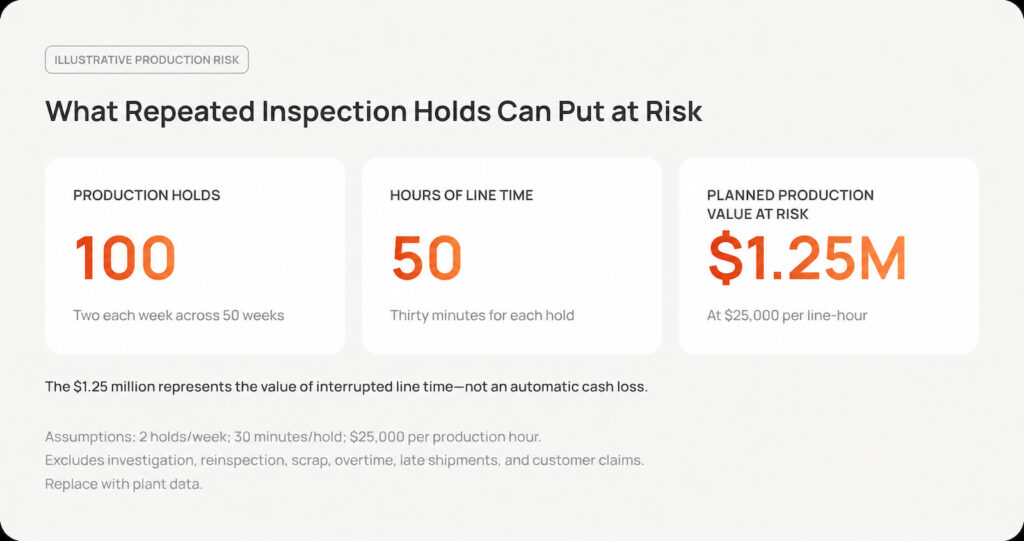
In one illustrative scenario, repeated holds put $1.25 million in planned annual production value at risk. That figure reflects 50 hours of line stoppages at $25,000 per hour in planned output value, not measured customer loss or projected savings.
Actual impact varies by plant and by whether delayed output can be recovered.
The broader integration problem is documented in Hexagon’s 2026 survey. Among 511 U.S. manufacturing professionals, 67% reported that data from most systems was not integrated into a single view.
The survey highlights disconnected data across manufacturing, rather than measuring this specific inspection problem.
For operations leaders, investigation takes staff time away from production. Executives approving automation need to account for the work required after detection, including record matching and exception review.
Keep the evidence with the event
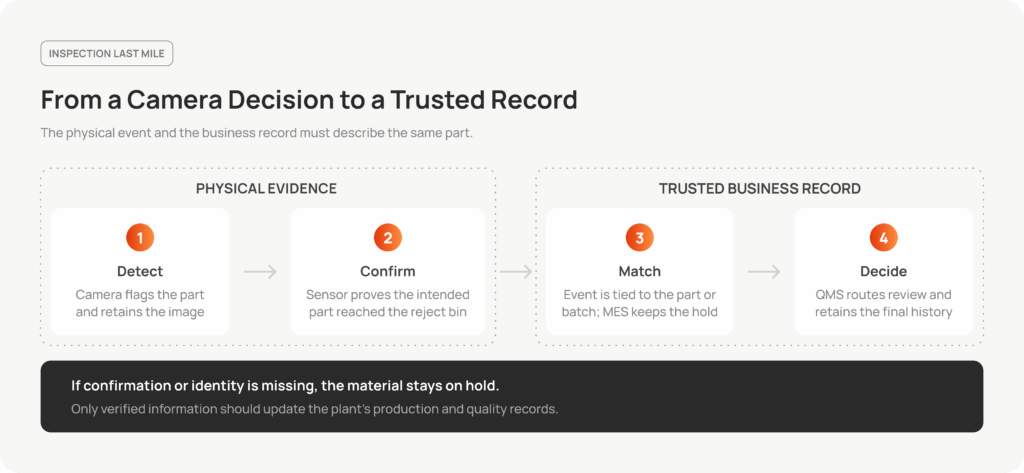
A programmable logic controller (PLC) controls machine actions, including triggering rejection. A sensor can confirm that something reached the reject location.
Neither signal alone proves that the intended part was removed from the production line.
The inspection result, part identity, and rejection confirmation must describe the same event.
The machine needs to act within its operating cycle, without waiting for production or quality software. Recording that action must preserve its connection to the affected part.
We design the workflow around existing plant systems and procedures. The manufacturing execution system (MES) can record the item and its status.
The quality management system (QMS) can route exceptions to an authorized reviewer.
A verified record supports that person’s decision. It doesn’t automatically authorize shipment.
Follow one part through the records
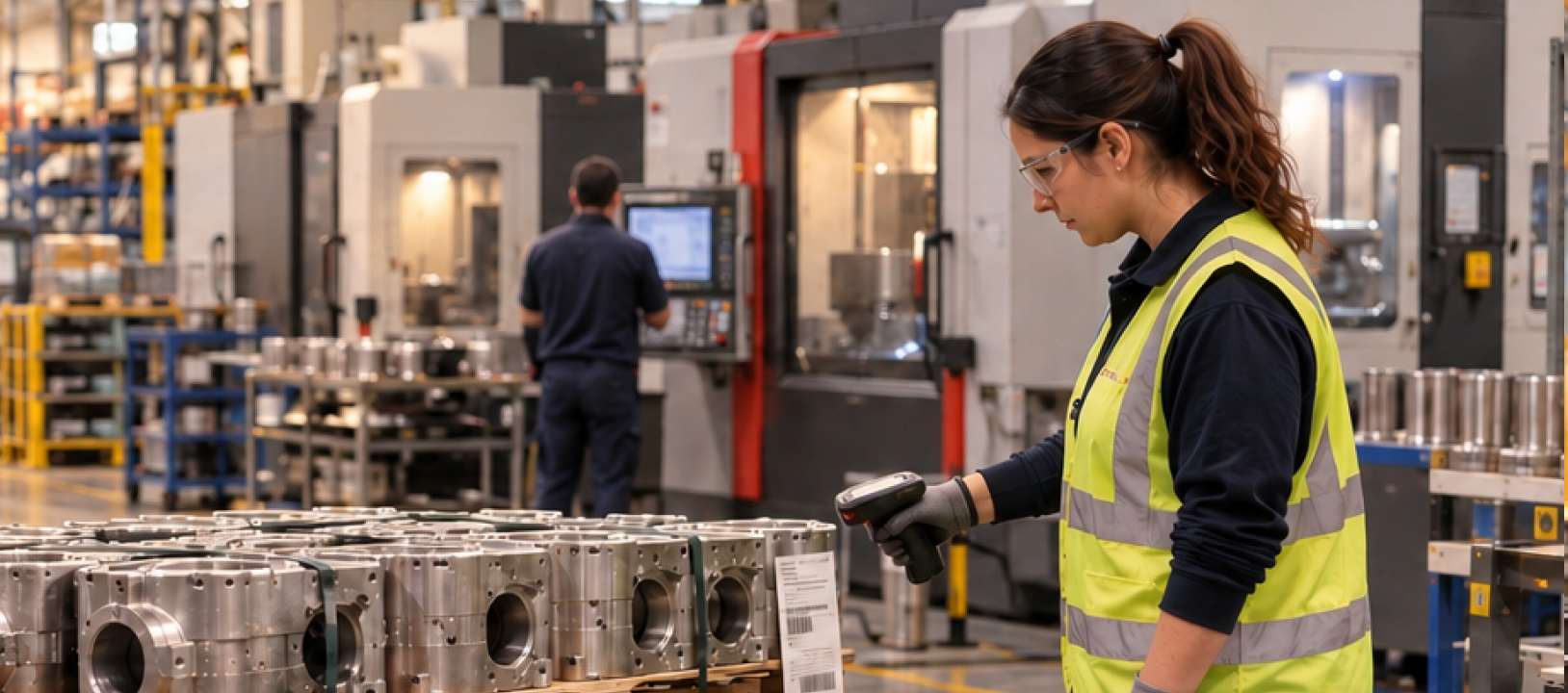
Begin with a rejected part. Can the team retrieve its inspection image, identify the part or batch, and confirm that the intended rejection occurred?
Then, examine the records. Do they agree about the event and material involved? When evidence is missing, does someone own the next step?
Preserve the original result alongside the decision history: who acted, when, and why.
Recording an exception keeps uncertainty visible. A completed machine action shouldn’t quietly close an unresolved quality question.
How we connect the last mile
Our IoT engineering capabilities connect cameras, sensors, and software to bring inspection evidence into the plant’s quality workflow.
We work with the equipment already operating in the plant to link events to parts, retain images, confirm rejection, and route exceptions for review.
The aim is to give the responsible team evidence it can follow, rather than another event it has to reconstruct.
For repeated inspection holds, discuss a Manufacturing Systems Assessment with Softarex focused on gaps between rejection evidence and quality decisions.