







Walk a plant with a “twin” program underway and you often find the same artifact: a polished 3D cell model fed by a nightly export, showing a state that stopped being true hours ago. It looks advanced. It is not digital twin manufacturing. It is a visualization with a marketing label.
NIST frames a digital twin as a particular type of computer model of a physical system with the potential for high accuracy and flexibility across monitoring, simulation, optimization, and decision support – and treats forecasting and continuous use of models against the real system as foundational, not optional (Digital twins | NIST). AWS’s industrial guidance is blunt in the same direction: a production-grade twin goes beyond static 3D; it ingests live data, supports prediction, and stays coupled as equipment ages (Build L1–4 Industrial Digital Twins with OpenUSD and SDMA on AWS).
The Softarex thesis is narrower and more operational: the live data backbone is the real product. Modeling tools are buyable. Simulation engines are buyable. What you cannot buy as a finished SKU is a governed, time-aligned, semantically consistent flow of state from your mix of legacy PLCs, historians, MES, cameras, quality systems, and ERP – wired so operators and engineers can trust it under production pressure.
Why digital twin projects stall at the data layer
Twin failures rarely show up as “our broker topology is wrong.” They show up as “the model is wrong,” “operators ignore it,” or “we cannot validate the prediction.” Underneath, the same failure modes repeat:
- No signal – the decision variable was never measured. Spindle load exists; surface finish, manual-station dwell, or true buffer occupancy do not.
- Wrong signal – the tag exists, but units, scaling, or meaning differ by line or shift.
- Late signal – batch ETL and nightly snapshots arrive after the decision window closed. Operators who see stale values once stop trusting the screen.
- Unlabeled signal – history exists without scrap reasons, planned-vs-unplanned stops, or defect classes, so prediction has no ground truth.
- Untrusted signal – clocks disagree across PLC, historian, MES, and ERP, producing impossible sequences.
None of these is fixed by a better renderer. Each needs instrumentation choices, semantic ownership, streaming design, and time discipline.
Maturity is a data ladder, not a graphics ladder
A useful way to keep scope honest is a four-rung ladder (vendor-published, not independent law of nature):
- Descriptive model – geometry/process representation with no live binding.
- Monitoring twin – live state bound to an asset model, with history.
- Predictive twin – forecasts on top of reliable history and current state.
- Living twin – continuous recalibration and controlled write-back under human authority.
AWS’s L1–L4 framing makes the dependency explicit: each level needs the one below it (Build L1–4 Industrial Digital Twins with OpenUSD and SDMA on AWS). Jumping to “predictive” on nightly CSV dumps is how programs burn a year proving a model that operations never uses.
“Our data isn’t ready” is use-case specific
Some decisions tolerate imperfect data: energy attribution, changeover duration, coarse downtime coding, cycle-time variance, multi-line benchmarking. Others do not: closed-loop setpoint changes, quality release evidence, safety-adjacent interventions, customer-facing genealogy claims.
Sequence the program accordingly. Use tolerant use cases to prove the backbone. Earn the right to intolerant ones.
The live data backbone: what competitors skip
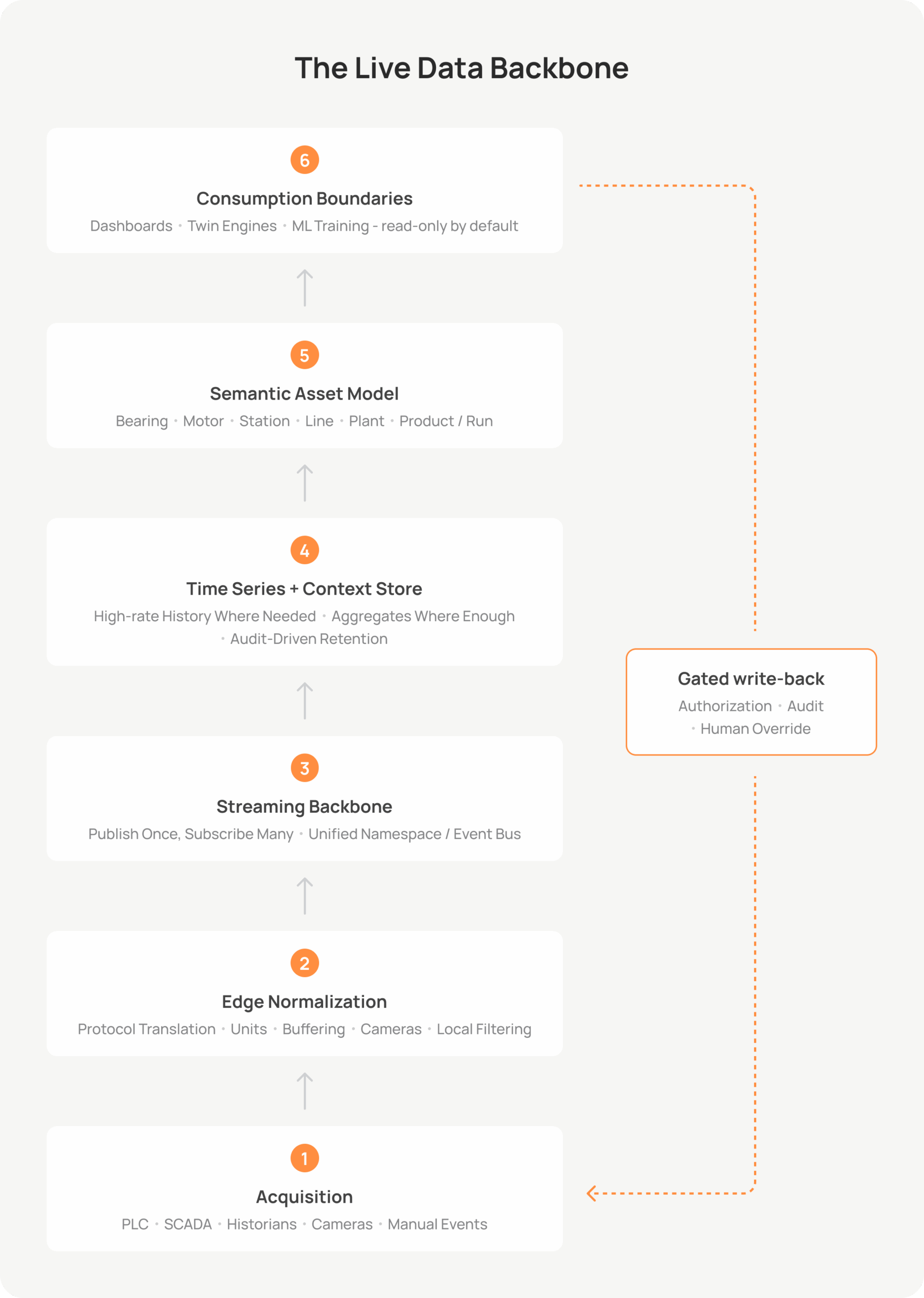
Most twin content jumps from “connect sensors” to “visualize insights.” The hard layers sit in between:
- Acquisition – PLC/SCADA/historian/camera/manual events, including retrofit sensors on closed controllers.
- Edge normalization – protocol translation, units, buffering, local filtering. Edge is where a network hiccup becomes delayed truth instead of a permanent hole.
- Streaming / pub-sub backbone – publish once, subscribe many. Point-to-point pipes are fine for two systems and catastrophic at plant or multi-site scale. A unified namespace / event bus pattern is architecture work, not a license checkbox.
- Time-series + context store – high-rate history where needed; aggregates where enough; retention tied to audit and model needs.
- Semantic asset model – bearing → motor → station → line → plant → product/run. Without hierarchy and identity, every root-cause question becomes manual archaeology.
- Consumption boundaries – dashboards, twin engines, and ML training stay read-only by default. Write-back to recipes, setpoints, or schedules needs authorization, audit, rate limits, and a human override path.
This is where Softarex usually spends the real engineering budget: brownfield protocol reality, event contracts, MES/SCADA/QMS wiring, and making the twin a consumer of a plant data product – not a parallel science project.
Latency budgets by decision, not by slogan
Stop asking for “real time.” Work backward from the decision:
- Controller interlocks and hard control loops: stay in the PLC; do not pretend the twin owns them.
- Operator intervention on a running process: seconds.
- Inline vision reject: within cycle time, which forces edge inference.
- Shift throughput / quality trend / maintenance planning: minutes.
- Capacity studies and engineering what-if: hours or daily.
AWS’s CPG twin write-up makes the same practical point in different words: update frequency should follow how fast the underlying system changes, not a universal sub-second fetish (Digital twins and CPG manufacturing transformation | AWS for Industries).
Discrete vs process patterns
Discrete plants are event-dense: cycle starts, station pass/fail, serialized genealogy. Process plants are continuous and lagged: temperature, pressure, flow, residence time. Hybrid packaging lines need both patterns joined at the changeover boundary. Copying a process historian pattern onto a high-mix discrete line (or the reverse) is an expensive category error.
Computer vision as a sensor tier, not a side demo
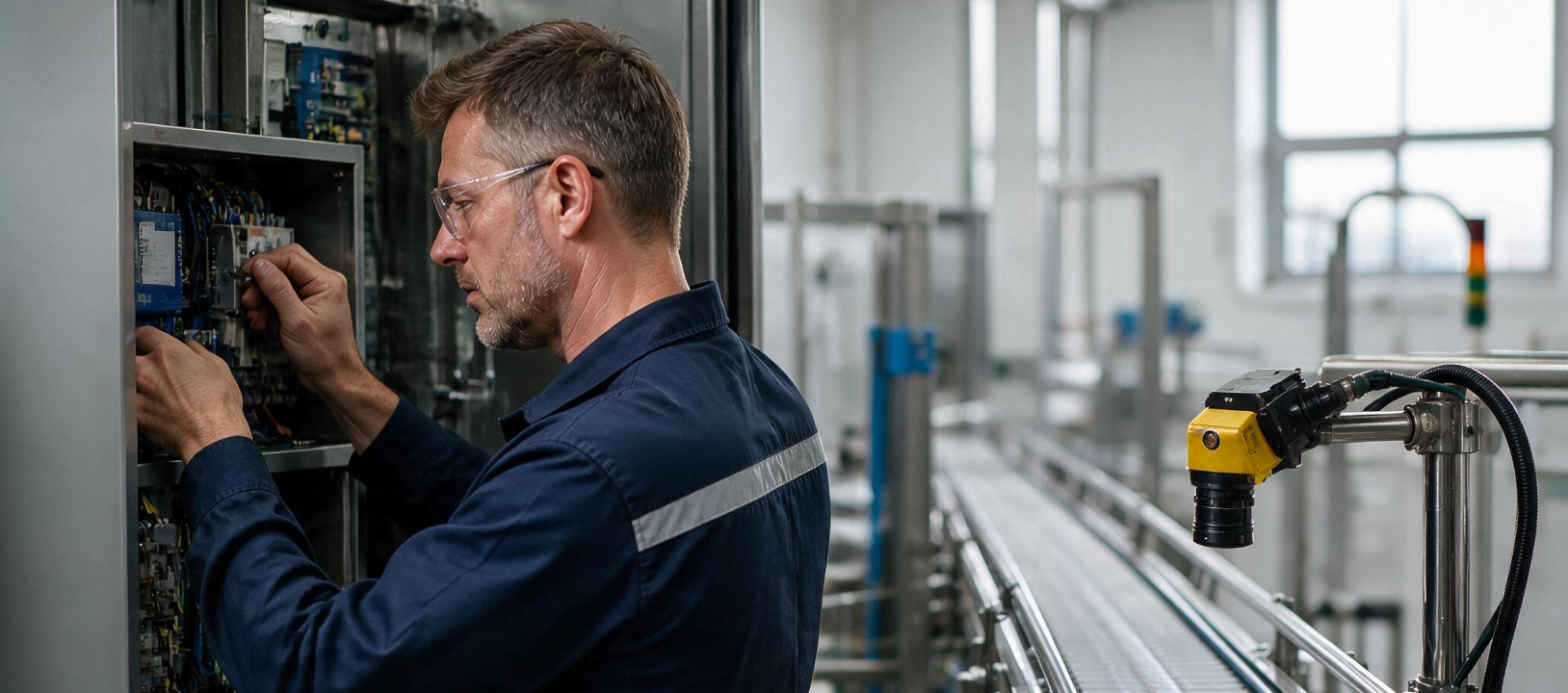
Many twin programs stall after the PLC tag inventory because the decision they care about is not in the controller. That is often a sensing problem, not a twin-platform problem.
Cameras can publish state no PLC exposes: surface defects, assembly completeness, fill/seal/label integrity, buffer occupancy, and cycle timing on closed machines. Softarex’s production computer-vision work sits here as sensing + eventing, not a separate AI slide.
One rule decides whether vision helps the twin: vision events must share the same time base and asset/part identity as process data. A standalone inspection app with its own clock is a rejection counter. Bound into the backbone, every defect becomes correlatable evidence. Edge vs central inference, drift checks after lighting or tooling changes, and visible confidence/”unable to evaluate” states are table stakes.
Build, buy, or partner without self-deception
Platform feature lists converge. What does not: who owns the asset model; whether outsiders can subscribe to contextualized data or only open a UI; coverage of your legacy PLC mix; write-back audit; and 12–18 months of streaming/data-ops capacity.
Buy for speed on standard connectors and rendering. Build or partner for backbone ownership and plant-specific decision logic. Softarex’s natural role is the second bucket: custom integration and AI/CV around systems you already run, with exportable semantics so the twin is not hostage to one vendor schema.
NIST’s manufacturing twin emphasis on requirements, data management, model validation, and actionable recommendations is useful procurement vocabulary even outside a NIST testbed (Digital twins | NIST). Specify interfaces and ownership; do not accept “dashboard included” as architecture.
Pilot design that can survive contact with a second line
Scope is the difference between a fleet program and a memorial demo.
- Pick one line and three decisions (example: changeover loss, escape defect correlation, unplanned stop reconstruction).
- Inventory signals against those decisions; list gaps honestly.
- Implement backbone layers only as far as those decisions need.
- Define success metrics operators recognize: trust (do they look?), time-to-insight, false-stale rate, decision latency met/missed.
- Only then add prediction or write-back.
NIST publishes large-scale estimates of U.S. discrete manufacturing losses from downtime and defects and potential twin-related benefits in its AMS materials referenced from the digital twins hub; treat those as national-scale estimates with stated scope, not as your plant’s business case (Digital twins | NIST). Your pilot still needs local baseline: scrap, stops, overtime, escaped defects, and the specific decision the twin is supposed to change.
Build the backbone, then the twin
If your digital twin manufacturing roadmap starts with a render and ends with a data cleanup project, invert it.
Start with decisions. Design the live data product those decisions require. Bind vision and other non-PLC sensors into the same identity and time contracts. Climb the maturity ladder only as fast as the backbone earns trust. Keep Softarex-style custom integration where brownfield reality and ownership matter; buy commodity pieces where they are truly commodity.
The twin people trust is rarely the prettiest model. It is the one whose numbers match the line when the shift is under pressure.
Next step: if you are evaluating a twin program, run a data-readiness and signal-gap assessment on one candidate line before you buy another visualization layer. Softarex can help scope that assessment around your actual PLC/MES/vision constraints and the three decisions that would justify the backbone.
References
- Digital twins | NIST
- Build L1–4 Industrial Digital Twins with OpenUSD and SDMA on AWS
- Digital twins and CPG manufacturing transformation | AWS for Industries
- Computer Vision Development Services | Softarex
- Computer Vision & AI Systems for Manufacturing Operations | Softarex
- Custom IoT Application Development Services | Softarex