




Drive-thru computer vision order accuracy sounds like a narrow technical problem until a wrong order becomes expensive in a very boring way. It creates waste, slows the lane, triggers refunds or remakes, and leaves the guest with one simple memory: the restaurant could not get the basics right.
That is why drive-thru order accuracy deserves more than another headset upgrade or generic AI pilot. QSR operators already measure speed, window time, friendliness, food quality, and order accuracy as operating metrics. The 2025 QSR Drive-Thru Report, produced with Intouch Insight, looked at 2,265 mystery-shop orders across 13 QSR brands in the U.S. and reported overall order accuracy of 87 percent, versus 89 percent in 2024. That means accuracy is not an abstract CX complaint. It is a measurable operating gap.
Computer vision fits there: not as a magic replacement for staff, and not as another dashboard nobody checks, but as a fulfillment-side verification layer connected to POS, KDS, timing, and store operations.
Order accuracy has multiple failure points
Drive-thru errors usually start in one of three places.
First, there is order capture. The guest is misheard, a modifier is missed, or the POS entry does not match the request. Voice AI, order confirmation boards, and better speaker systems can help here.
Second, there is assembly. The order was captured correctly, but the wrong item, size, ingredient, or packaging step happens in the kitchen.
Third, there is handoff. The right order exists, but the wrong bag reaches the wrong vehicle, an item is left behind, or the crew has no fast way to confirm the bag contents during peak pressure.
Most AI drive-thru discussions collapse these problems into one bucket. That is a mistake. Voice AI improves the order as it enters the system. Computer vision verifies the physical work after the order is already in motion. The two layers are complementary.
The QSR report makes that separation useful. It found that order accuracy was 26 percentage points higher when the order confirmation board was displayed correctly, and 16 points higher when the speaker interaction was clear and understandable. Those are capture-side signals. Computer vision should extend that same discipline into assembly and handoff, where the restaurant needs proof that the physical order still matches the digital order.
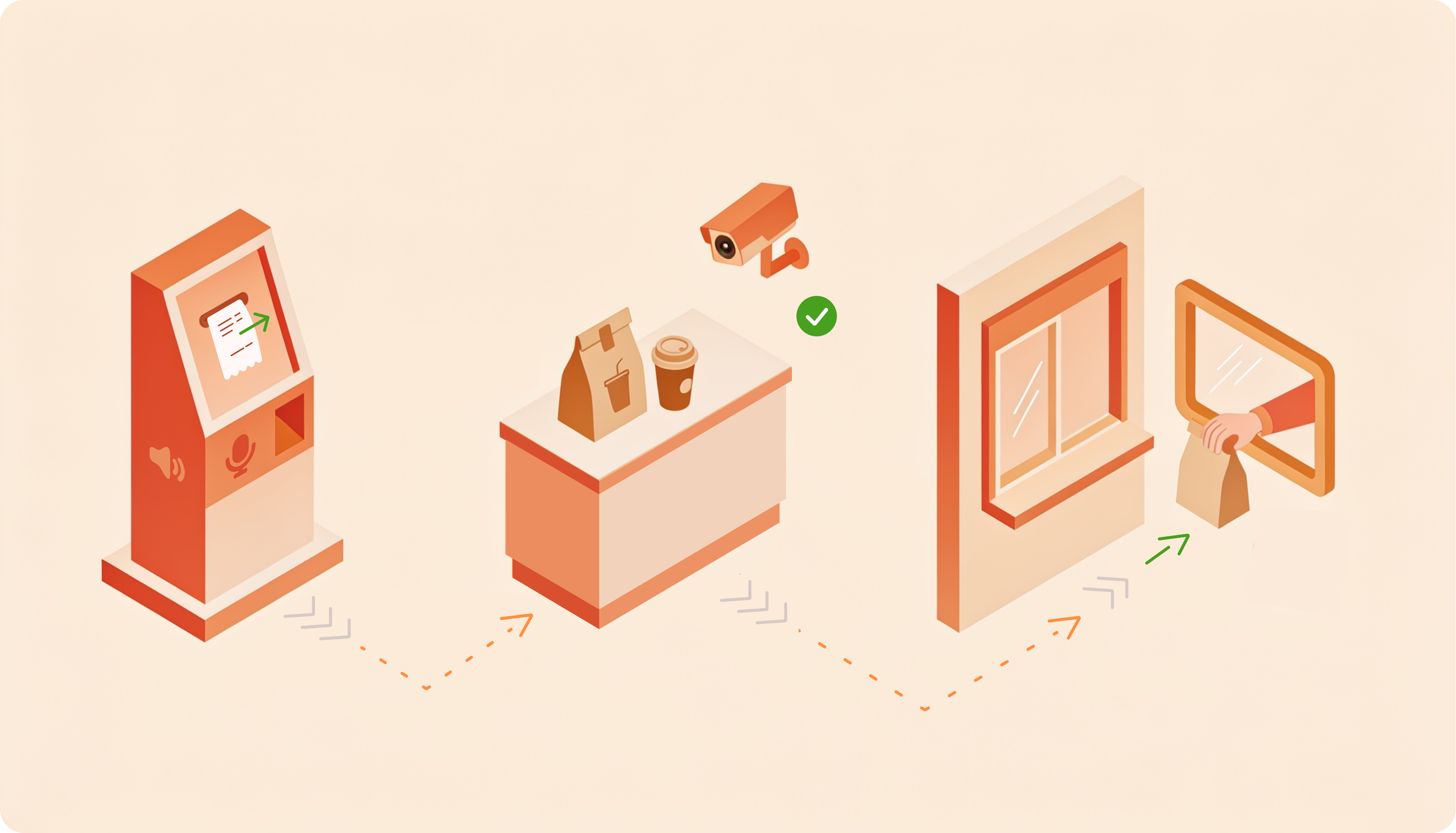
Where computer vision actually helps
A useful vision system watches the points where physical reality diverges from digital intent.
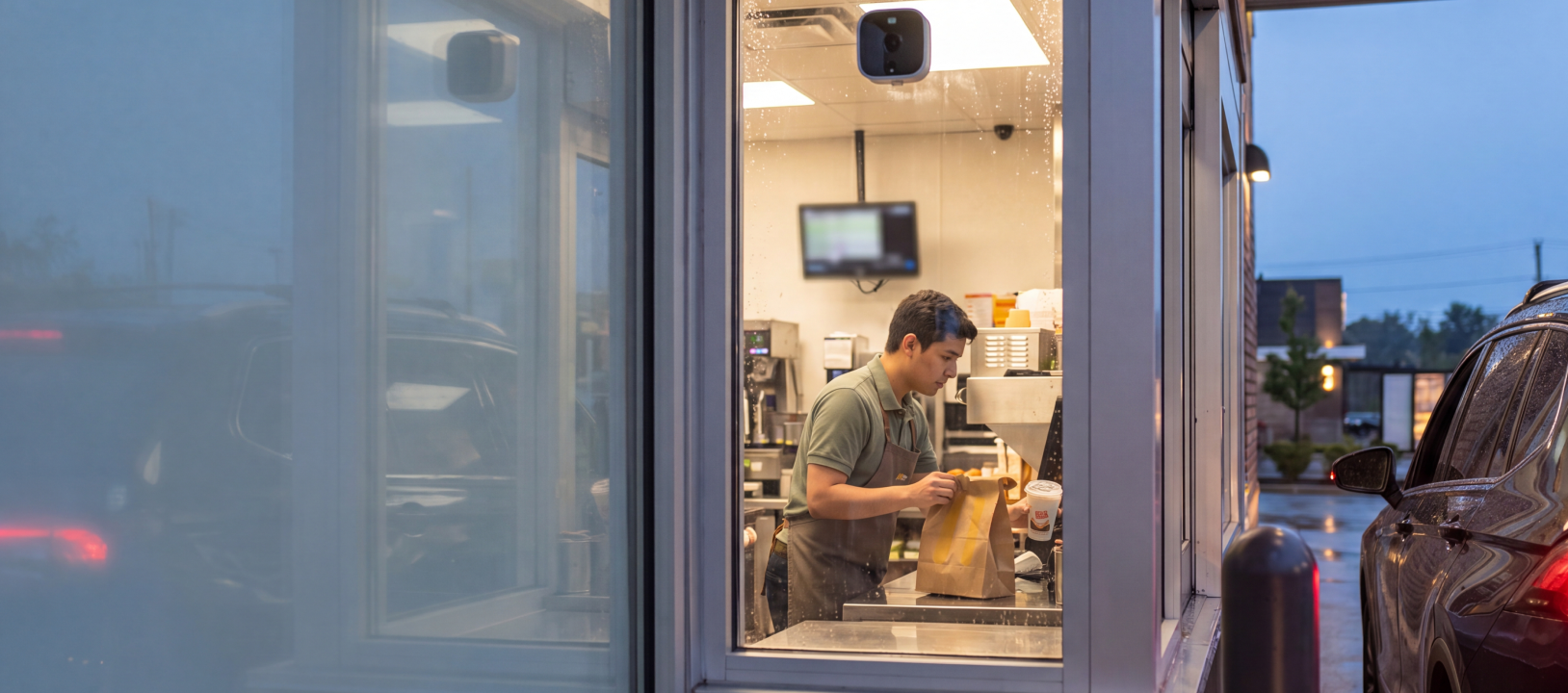
In practice, cameras may sit at assembly, bagging, pickup, lane entry, or window zones. The model detects visible items, packaging, trays, bags, vehicle events, and process steps. Those detections are matched against the live POS or KDS order manifest. If expected and observed items do not line up, the system raises an exception before the bag crosses the window.
That is the difference between after-the-fact analytics and operational control. A report that says accuracy slipped last Friday is useful, but it does not save the order currently sitting on the counter. A real-time alert at bagging can.
Computer vision can support several QSR use cases:
- item and package verification before handoff;
- missing-item and wrong-size detection;
- order-to-vehicle matching in multi-lane or pull-forward flows;
- queue, dwell-time, and abandonment measurement;
- kitchen step monitoring for high-volume or high-error stations;
- exception review for training and process improvement.
Presto describes computer vision as a way to measure drive-thru touchpoints such as menu-board time, payment-window time, pickup-window time, and exit time. A Plainsight viewpoint published in Restaurant Technology News describes vision AI in QSR as useful for arrival detection, wait-time monitoring, abandonment alerts, and food-prep analysis. Aragon Research has also described Agot AI’s use of ceiling cameras and computer vision to check whether fast-food orders are prepared and bagged correctly.
The pattern is consistent: vision is strongest when it turns store events into structured operational signals. It is weakest when it is sold as a standalone AI feature with no connection to workflow, crew behavior, or order data.
The architecture matters more than the demo
A demo can recognize a burger on a clean counter. A production system has to survive glare, steam, rushed crew movement, changing packaging, seasonal menu items, network drops, and franchise layout differences.
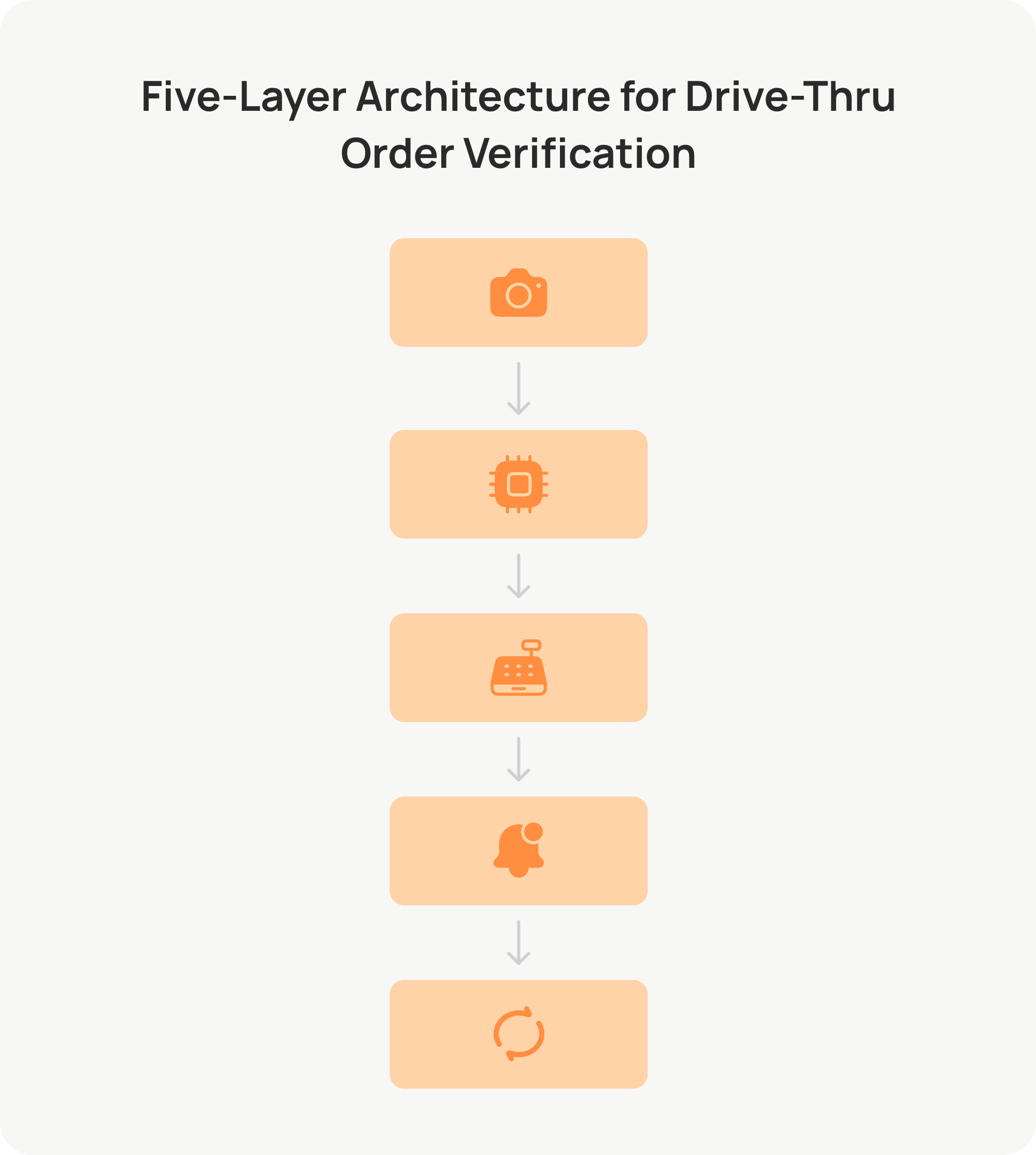
A serious implementation needs five layers.
1. Capture layer. Camera placement decides whether the model has usable evidence. Overhead assembly views are useful, but bagged items create occlusion. Stronger setups often combine a view before bagging with a view of bagging or handoff. Lighting, reflection, weather exposure, and crew workflow matter as much as model choice.
2. Edge inference. Time-critical checks should usually run close to the store. Edge inference reduces latency and keeps the alert loop alive during network problems. Cloud systems still have a role for fleet analytics, retraining, reporting, and model deployment.
3. POS and KDS integration. Vision without order data is just observation. To verify accuracy, detections must be compared with the order manifest: item IDs, modifiers, quantities, packaging rules, timing, and lane or vehicle context. This integration layer is where many pilots get stuck.
4. Decision and alerting layer. Staff will ignore vague warnings. The system needs explainable exceptions: “missing fries,” “wrong drink size,” “bag does not match order 184,” or “handoff sequence mismatch.” False positives are operational debt. If the crew stops trusting alerts, the system is dead.
5. Model lifecycle. QSR menus change constantly. Limited-time offers, new packaging, regional SKUs, and recipe changes will degrade a model if nobody owns retraining. Labeling, validation, versioning, rollback, and drift monitoring are not nice-to-have items. They are the operating model.
This is where a Softarex-style delivery approach matters. The value is not only in training a detection model. The hard part is connecting computer vision, ML, IoT signals, POS/KDS data, alerting, analytics, security, and lifecycle operations into one system that works under store pressure.
What to measure in a pilot
Do not start with a chain-wide rollout. Start with a controlled pilot that answers one question: does vision improve real outcomes without slowing the lane or annoying the crew?
Measure before installation. You need a baseline for:
- remake and refund rate;
- missing-item complaints;
- order accuracy audits;
- pickup-window time;
- total drive-thru time;
- alert-to-correction time;
- false-positive and false-negative rates;
- staff override and ignored-alert rate.
Model accuracy alone is the wrong KPI. A model can look good in a test set and still fail in the restaurant if it alerts too late, misses occluded items, or creates extra steps during rush periods. The pilot should measure operational accuracy: how many real mistakes were prevented before handoff, and at what cost to speed and labor flow.
Pilot stores should reflect reality, not the cleanest showcase location. Include different layouts, volume levels, dayparts, lighting conditions, and crew maturity. If the system works only in a tidy store with stable traffic, it is not ready for franchise scale.
Privacy and staff trust cannot be bolted on later
Drive-thru video can capture people, cars, license plates, and employee activity. Privacy, retention, access control, and purpose limitation have to be designed from the beginning.
A practical policy should define what is recorded, what is processed on-device, what leaves the store, how long footage or metadata is kept, who can review it, and whether data is used for coaching, compliance, analytics, or dispute resolution. The safest default is to minimize raw video retention and keep only the metadata needed for accuracy, timing, and exception review.
Staff trust matters too. If employees experience the system as surveillance theater, adoption will suffer. If they experience it as a tool that catches mistakes before customers complain, adoption gets much easier. Product design should make that distinction visible.
Build, buy, or integrate?
For a small number of stores, a packaged vendor tool may be the fastest route. For a larger QSR or franchise network, the decision is more complex.
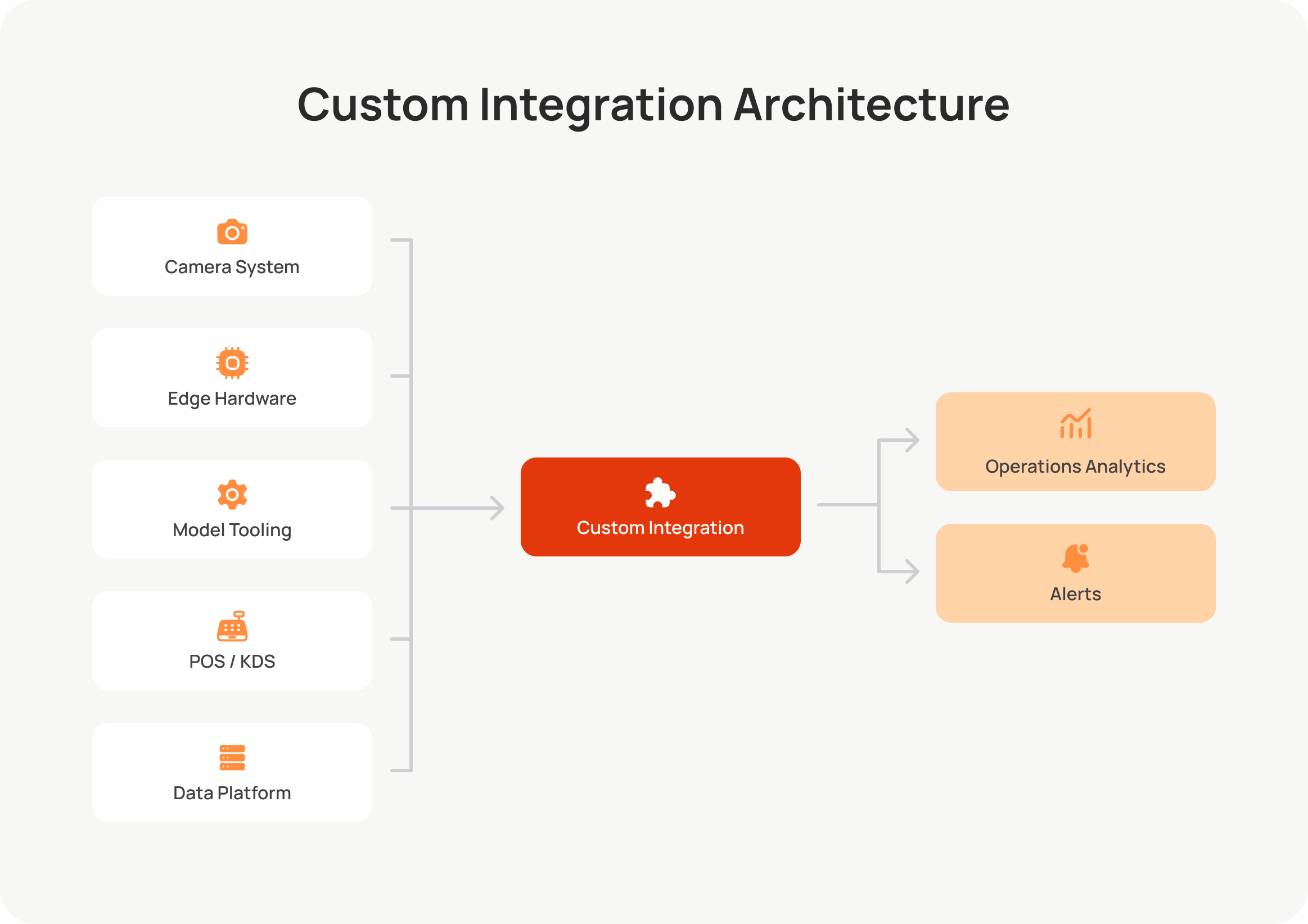
Buying can reduce time to pilot, but may lock the operator into a specific camera stack, POS connector, data model, or reporting layer. Building everything from scratch gives control, but increases delivery risk and maintenance burden. The practical middle ground is often custom integration around selected components: proven cameras, edge hardware, model tooling, POS/KDS connectors, and a data platform that the operator can actually own.
Softarex is strongest in that middle layer. We are not interested in selling computer vision as theater. The useful work is system integration: taking store-level visual signals, matching them to live order data, turning exceptions into clear crew prompts, and giving operations leaders clean evidence across locations.
The real goal: fewer preventable misses
Computer vision will not make the drive-thru fully autonomous, and it should not be sold that way. It will not fix bad menu design, poor staffing, broken headsets, or weak kitchen process.
But it can give QSR operators something they rarely have today: a real-time view of whether the physical order matches the digital order before the guest leaves.
That is the useful version of AI in the drive-thru. Not hype. Not a futuristic lane. A verification layer that catches preventable misses, measures the real bottlenecks, and gives operators evidence they can act on.
For QSR teams planning a drive-thru accuracy initiative, the smart starting point is a scoped pilot: one or two workflows, clear baseline metrics, integration with the live order manifest, and a hard test of whether alerts change outcomes during peak pressure. If it works there, then it is worth scaling.
References
- The 2025 QSR Drive-Thru Report – QSR Magazine
- Drive-Thru Study 2025 Press Release – Intouch Insight
- Drive-Thru Study 2025 – Intouch Insight
- Computer Vision: Optimize your drive-thru with real-time data – Presto
- How Vision AI Fast-Tracks Operational Efficiency and Service Excellence for Quick-Service Restaurants – Restaurant Technology News
- Agot.AI Brings Computer Vision to Fast-Food – Aragon Research