







Manual food safety checks are still everywhere in QSR kitchens: temperature logs, shift checklists, manager sign-offs, and binders that look fine until something goes wrong. The problem is not that teams do not care. The problem is that fast-service kitchens move too quickly for periodic checks to catch every exception.
A walk-in cooler can drift out of range between checks. A hot-holding unit can sit close to a threshold for hours. A corrective action can happen but never make it into the record. Across ten stores, this is annoying. Across hundreds of franchised locations, it becomes a compliance and operating-risk problem.
Real-time kitchen monitoring changes the model. Instead of asking staff to prove after the fact that the kitchen was safe, the system captures conditions continuously, flags exceptions quickly, and preserves the record needed for inspections, audits, and internal quality reviews.
For QSR CTOs and operations leaders, the decision is not whether sensors or AI sound interesting. The decision is where monitoring actually reduces risk, what should be automated first, and how to integrate the data without creating another system nobody owns.
Why manual checks break at QSR scale
Food safety compliance depends on repeatable execution. That is exactly where QSR operations are hardest to control.
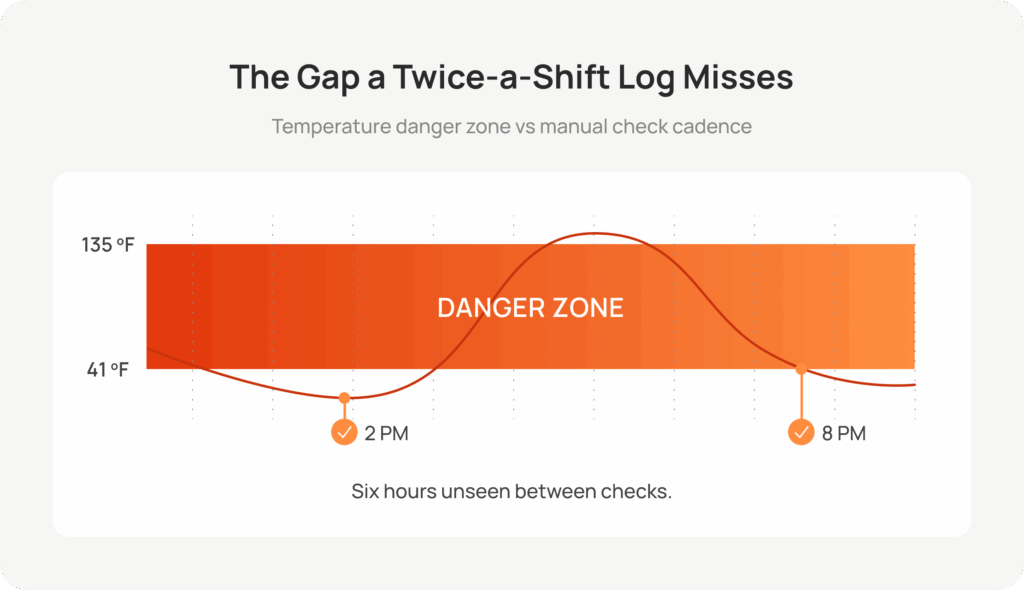
Stores run with changing crews, high-volume rushes, equipment variation, and different levels of manager attention. A paper log captures a point in time. It does not show what happened between checks, whether an alert was missed, or whether the same issue repeats every Tuesday night in five locations.
Temperature control is the obvious example. FDA guidance around Time/Temperature Control for Safety foods treats the 41°F to 135°F range as the danger zone where pathogen growth becomes a concern. If a cooler warms overnight or a holding cabinet drifts during peak hours, a manual check may catch it late or miss it entirely.
Paper logs also create weak evidence. They can be incomplete, backfilled, illegible, or disconnected from corrective actions. Even when the team does the right thing, the record may not prove it. That matters during health inspections, internal audits, insurance reviews, and franchise quality checks.
Real-time monitoring does not remove human responsibility. It makes the work visible. The system should show what happened, when it happened, who was alerted, what corrective action was taken, and whether the issue closed. That is the difference between a checklist and an operational control system.
The practical monitoring architecture

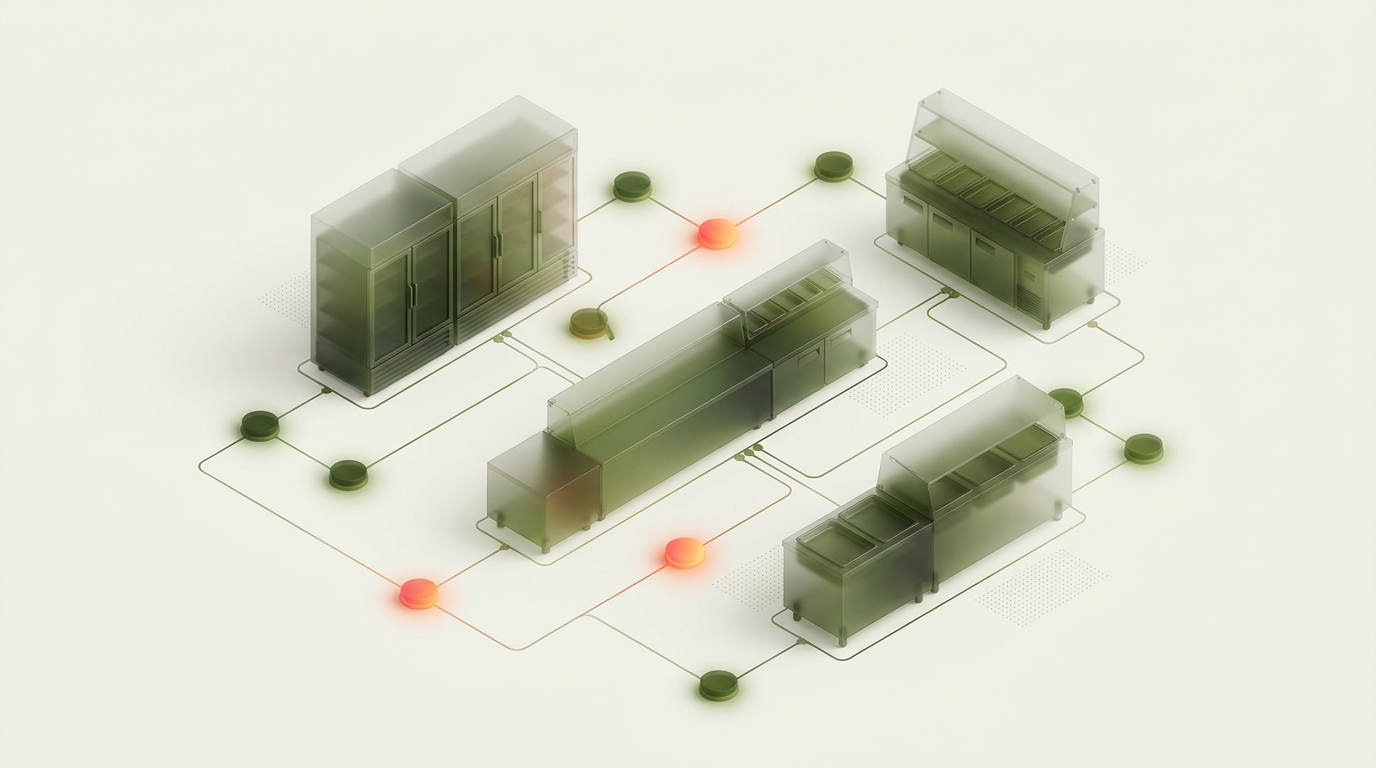
A useful QSR monitoring platform has three layers: sensors, vision, and a central data platform.
The sensor layer handles conditions that are easy to measure directly. Refrigerators, freezers, hot-holding equipment, prep areas, and storage zones can send temperature and equipment readings on a schedule. The system can detect threshold breaches, missing data, sensor drift, and repeated equipment issues.
The vision layer handles events sensors cannot see. Computer Vision can help monitor whether cooler doors are left open, whether staff follow handwashing or PPE procedures, whether food is uncovered in prep zones, or whether product sits outside expected handling windows. This is where teams need discipline. Vision should start with narrow, high-value use cases, not a fantasy list of everything a camera might someday detect.
The platform layer turns raw signals into operations. It stores timestamped records, applies rules, triggers alerts, escalates unresolved issues, and connects events to corrective actions. For multi-location QSRs, this layer matters as much as the devices. A local store dashboard is useful, but the real value comes from a central view across locations: which stores are repeatedly out of range, which alerts take too long to close, and where training or equipment maintenance is needed.
Edge processing also deserves attention. Kitchens lose connectivity. If the system cannot buffer readings locally and sync later, the exact gap an inspector cares about may become the gap in your data. For Computer Vision, edge processing can also reduce latency and limit how much video leaves the store, which helps with privacy and network load.
From alerts to corrective action
Alerts are cheap. Useful alerts are hard.
A food safety monitoring system should not just tell someone that something is wrong. It should route the exception to the right person, provide context, require a corrective action, and preserve the closure record. Otherwise, it becomes another noisy notification channel.
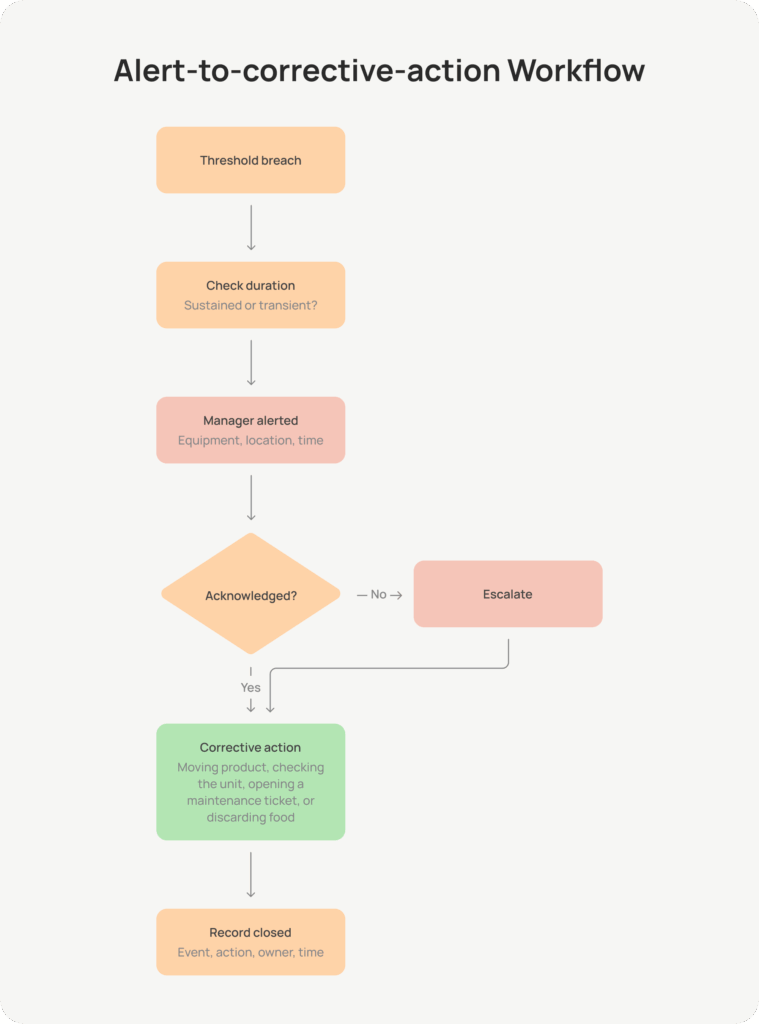
A good workflow looks like this:
- A cooler temperature crosses a configured threshold.
- The system checks whether the breach is sustained or transient.
- The store manager receives an alert with equipment, location, timestamp, and current reading.
- If the issue is not acknowledged, the alert escalates.
- The manager records the corrective action: product moved, unit checked, maintenance ticket created, or food discarded.
- The final record links the event, response, responsible person, and timestamp.
This is where integration starts to matter. Monitoring data becomes more valuable when it connects with maintenance, inventory, POS, KDS, labor, or food safety management systems. But integration should be selective. Connecting everything on day one usually creates fragile architecture and expensive support. Start with the workflows that change decisions.
For many QSR teams, that means temperature monitoring and corrective-action documentation first. Add Computer Vision after the operating model is stable and the team knows which blind spots are worth the extra complexity.
Compliance and audit readiness
HACCP thinking is useful here because it forces teams to identify control points, monitor them, define corrective actions, and keep records. A real-time monitoring platform should support that discipline rather than invent a separate compliance language.
The system should make it easy to answer basic audit questions:
- Which control point was monitored?
- What threshold applied?
- When did the deviation start and end?
- Who was alerted?
- What corrective action happened?
- Is the record complete and tamper-resistant?
That recordkeeping layer is not just bureaucratic. It protects the business when something is questioned later. If a store claims the cooler stayed in range, the system should be able to show the readings. If a deviation happened, it should show the response.
FSMA traceability requirements add another reason to take records seriously, especially for operators handling foods covered by traceability rules. The exact legal obligations and enforcement timing should always be verified against current FDA guidance before publication or implementation. The broader point is stable: food businesses need cleaner digital records and faster access to operational evidence.
This is not legal advice. It is an architecture principle. Build the monitoring system so food safety leaders, operators, and auditors can trust the data.
Build, buy, or custom-integrate
Most QSR operators should not build every piece from scratch. Temperature sensors, gateways, and basic alerting tools are mature enough that buying often makes sense. The harder question is what happens around those devices.
Off-the-shelf tools can work well for a single use case: cooler monitoring, daily checklist digitization, or simple alerts. They become weaker when the operator needs franchise-wide analytics, custom escalation rules, integration with existing systems, or Computer Vision tied to specific kitchen workflows.
A custom-integrated approach makes sense when the monitoring system has to fit the business rather than the other way around. That usually means connecting devices, cameras, dashboards, alerts, audit trails, and internal systems into one operating model.
The buying criteria should be blunt:
- Can it work across corporate and franchised locations?
- Can it survive weak connectivity?
- Who owns calibration and device maintenance?
- How are false alerts tuned?
- Where is the data stored, and who controls it?
- Can the system prove corrective actions, not just detect exceptions?
- Can it integrate with existing POS, KDS, inventory, maintenance, and food safety tools?
Do not base the decision on vendor ROI claims. Run a pilot. Measure alert quality, closure times, data gaps, staff adoption, maintenance effort, and the cost of support per store. Those numbers matter more than polished payback math.
What Softarex would build first
The best first version is usually not the most ambitious one. For a multi-location QSR, Softarex would start with the monitoring layer that produces defensible value quickly: temperature and equipment sensing, centralized records, and corrective-action workflows.
Then we would add Computer Vision only where it solves a specific blind spot. For example, if stores repeatedly fail on prep-zone hygiene or cooler-door handling, a narrow visual model may be worth testing. If the problem is simply incomplete temperature logs, sensors and workflow automation should come first.
The goal is not a kitchen full of gadgets. The goal is a food safety monitoring system that staff can actually use and leaders can trust.
For QSR teams planning real-time kitchen monitoring in 2026, the strongest architecture is layered: sensors for measurable conditions, Computer Vision for selected behaviors, and a central data platform for alerts, corrective actions, and audit trails.
If you are evaluating that kind of rollout, Softarex can help design the architecture, integrate the systems, and build a practical path from pilot to fleet-wide deployment.